

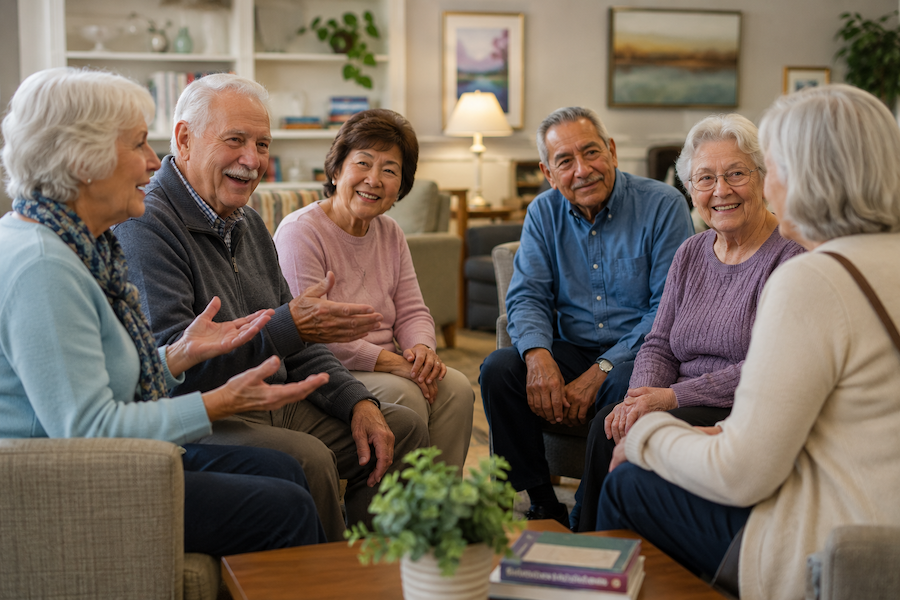
On the surface, retirement community living might not be at all attractive to an introvert. After all, social media, advertisements, and websites often highlight bustling dining rooms, group fitness classes, happy hours, clubs, outings, and other social activities. If you prefer a quiet evening with a good book over a crowded gathering, you may wonder whether community living is really for you.
Being an introvert doesn’t mean you don’t enjoy people or want meaningful relationships, though. It often means you prefer to socialize in smaller groups, appreciate quieter surroundings, and need time alone to recharge. When you look beyond the busy activities calendar, a retirement community can actually be an excellent environment for that kind of lifestyle.
The key to happiness for introverts in a retirement community is choice. A good match is a retirement community that offers opportunities to connect with others when you want to, while still providing a private home where you can enjoy your own space and your own routine.
Finding the right amount of “social”
One misconception about retirement communities is that residents are expected to participate in everything. In reality, an activity calendar is a menu of options, not a list of requirements.
You might have dozens of opportunities available during a typical week, but that doesn't mean you need to attend them all. Instead, you can choose the activities that genuinely interest you.
For an introvert, that might mean skipping the larger gatherings but participating in a book club with just six other residents. You may prefer a painting class, gardening group, lecture, movie night, card game, or small dinner with a few neighbors. Perhaps you enjoy an occasional group outing but prefer to spend the following day relaxing at home. Whatever your speed, retirement communities can make it easier to socialize on your own terms.
Smaller activities can lead to meaningful friendships
Introverts often prefer deeper connections with a few people rather than maintaining a large social circle. Retirement communities can provide plenty of opportunities for those relationships to develop naturally.
You may discover that the person who sits next to you at a weekly class shares your interest in history. Someone you meet while walking the community's grounds might become a regular walking companion. A neighbor could turn into a friend you meet for coffee once or twice a week. These connections can happen gradually, without the pressure of constantly introducing yourself to strangers or organizing social plans.
That's one of the advantages of living in a community: you're surrounded by potential friends, but you decide how and when those relationships develop.
Your residence is your personal retreat
One of the most important things for introverts to remember is that moving to a retirement community doesn't mean giving up privacy. Your apartment, cottage, or other residence is still your home.
You can close your door, read, watch television, listen to music, work on a hobby, talk with family, or simply enjoy some peace and quiet. You don't have to explain why you're skipping an activity or feel obligated to entertain anyone. In fact, this combination of community outside your door and privacy inside your residence can be one of the greatest benefits of retirement community living. When you feel social, activities and neighbors are nearby. When you've had enough interaction for the day, your private space is nearby, too.
Everyday socializing can become easier
Maintaining social connections can sometimes become more difficult during retirement, especially after leaving the workplace, moving away from longtime friends and neighbors, or the loss of a spouse.
For an introvert, creating a new social network from scratch can feel particularly daunting. Joining an unfamiliar organization, attending a public event alone, or driving across town to meet new people requires effort and initiative.
In a retirement community, many of those barriers disappear. You don't necessarily have to "go out and meet people." You're likely to encounter familiar faces naturally while checking the mail, having lunch, taking a walk, attending a fitness class, or participating in an activity.
Over time, those repeated casual interactions can make conversations and friendships feel much more comfortable.
Not all activities are about mingling
When touring retirement communities, look closely at the activity calendar. You may be surprised by how many programs are particularly well suited to people who don't enjoy large social gatherings.
Libraries, art studios, fitness centers, gardens, walking paths, educational programs, movies, discussion groups, musical performances, volunteer opportunities, and hobby clubs can all provide ways to stay engaged without requiring nonstop conversation.
Some activities even allow you to enjoy being around other people while primarily focusing on an individual pursuit. Think of working on a puzzle in a common area, reading in the library, exercising in the fitness center, or painting alongside other residents. You can feel connected to the community without always having to be the life of the party.
Less chores and responsibilities mean more time for what you enjoy
Retirement community living can also free up time and energy by reducing some of the responsibilities associated with owning a house. Instead of spending your weekend mowing the lawn, cleaning gutters, scheduling repairs, or worrying about what's going to break next, you may have more time for the things you genuinely enjoy.
For an introvert, that extra time might be devoted to reading, writing, woodworking, crafts, photography, genealogy, music, gardening, or another favorite hobby. And if you decide you'd like a little company, you don't necessarily have to travel far to find it.
Tips for finding a retirement community that fits your personality
Not every retirement community has the same atmosphere, so it's important to find one that feels comfortable to you. When you visit, don't focus exclusively on the size of the swimming pool or the number of activities on the calendar. Pay attention to how the community feels.
Are there quiet places where you could read or relax? Are there smaller gathering spaces as well as large common areas? Does the activity calendar include programs you would actually enjoy? Can you picture yourself having coffee in the courtyard or taking a walk around the property?
Ask whether you can have lunch with a few current residents or attend an activity during your visit. Experiencing the community firsthand can tell you much more than simply taking a tour.
Most importantly, consider your private residence. Does it feel like somewhere you would enjoy spending time? Your apartment or cottage should feel like your own personal sanctuary, not simply a place to sleep between community activities.
The best of both worlds
Being an introvert doesn't mean living an isolated life, it means you may be happiest when you can decide when, where, and how you interact with others. That's exactly why the right retirement community can be such a surprisingly good fit.
You can attend dinner with friends tonight and enjoy dinner at home tomorrow. You can participate in a class in the morning and spend the afternoon reading. You can develop close friendships without filling every day with social obligations.
Retirement community living doesn't have to mean being surrounded by people every minute of the day. At its best, it gives you something much more valuable: the freedom to choose between connection and solitude whenever you want either one.
Is Independence Hill Retirement Resort a good fit for you? Find out for yourself
See Independence Hill Retirement Resort in San Antonio for yourself: schedule your tour today. Have questions? We’re here to help! Call (210) 615-4000 to talk with a knowledgeable and experienced team member.